

Good evening and welcome to Wake The Dawn. In this project I will delve into a hymn or Christian song, exploring the history and life of the hymnist. My goal is to encourage, put out beautiful music, and provide a little background on the songs the Christian church has been regularly singing for hundreds of years. The diversity of hymnists and psalmists that have written Christian music make it a unique genre. They come from all walks of life and situations – brought together by Christ – writing about struggles, praises, fears, and triumphs. And to me it is fascinating to learn their stories.
Tonight we’re going further back in time than in the last episode, visiting a hymn written by Frances Ridley Havergal, in 1874 (Hendon, Hymnology Archive). Frances Havergal was born on the 14th of December, in 1836, to William and Jane Havergal. William Havergal was a rector of Astley, Worcestershire. Frances was the youngest child of six – Jane, Henry, Maria, Ellen, Francis (Frank), and Frances Ridley Havergal.
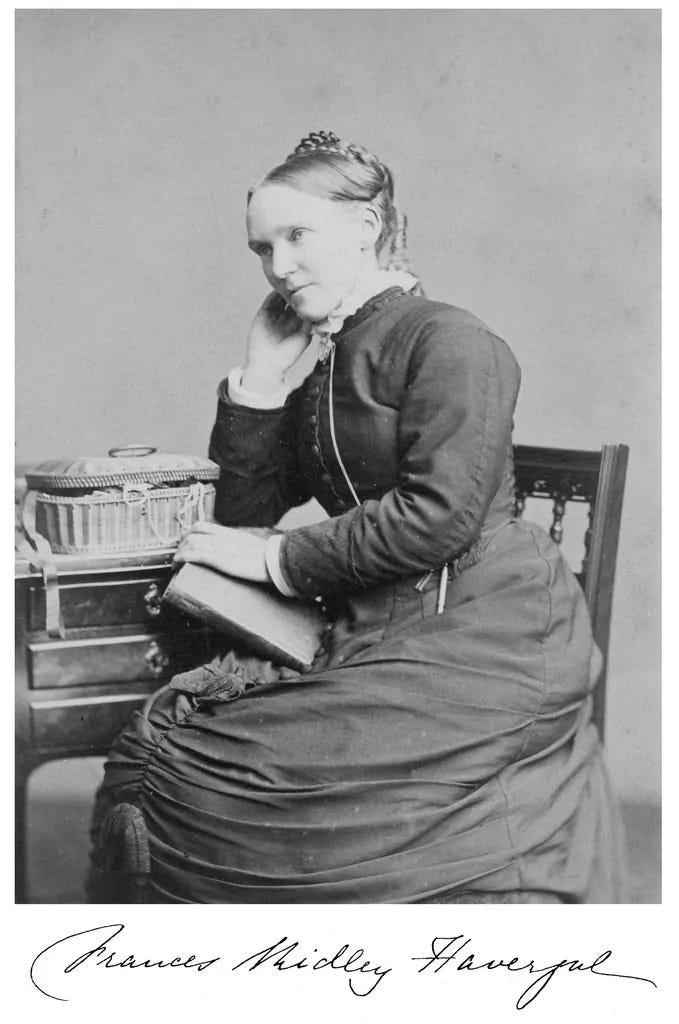
According to her sister, Miriam (presumably Jane, as her middle name was Miriam), Frances started speaking early and better than the usual child (Havergal, 1881). She had larger vocabulary, was more fluent, and could read easy books at the age of three. At four she could read the Bible, according to her sister, and was a precocious child. Apparently, when she was young, she would secretly listen along as her other siblings learned German, and came to pick it up (Havergal, 1881). Altogether, she seemed a bright, lively child.
At the age of 22, Frances wrote an autobiography of her inner life for her sister Maria in case of her death, so her loved ones would know how God had provided for and helped her. It was finished later, added to by Maria, and titled Memorials of Frances Ridley Havergal.
Frances writes that she began to be aware of religion at the age of 6 to 8, saying,
“I think I had a far more vivid sense of the beauty of nature as a little child than I have even now; and its power over me was greater than any one would imagine. I have hardly felt anything so intensely since, in the way of a sort of unbearable enjoyment. Especially, and I think more than anything else, the golden quiet of a bright summer’s day used to enter into me and do me good. What only some great and rare musical enjoyment is to me now, the shade of a tree under a clear blue sky, with a sunbeam glancing through the boughs, was to me then” (Havergal, 1881, p. 15).
Even in her prose writing, there is a lyricism in her words and her proclivity for writing is evident. Havergal also called herself a mischievous child, writing,
“I knew I was “ a naughty child,” never entertained any doubts on the subject; in fact, I almost enjoyed my naughtiness in a savage desperate kind of way, because I utterly despaired of getting any better, except by being “made a Christian,” which, as months passed on, leaving me rather worse than better, was a less and less hoped for, though more and more longed for, change” (Havergal, 1881, p. 16).
Her mother’s death at age 12 affected Frances tremendously and she struggled with her faith for years afterwards, feeling that she could not love God (Havergal, 1881). In 1850, after going to school and encountering some very helpful and loving teachers and classmates, Frances slowly started turning back towards God, but still felt distant and lost. In December a very good friend found Christ in a new and meaningful way, making an impact on Frances’s own journey. Finally, in February of the next year, at the age of 15 after a conversation with a mentor, Frances committed her life to Christ in trust and trembling and experienced the sweet joy that came with it.
Throughout her life, Frances suffered from poor health, passing away at the young age of 42, and much of her time on earth was marked by illness and recovery. She was closely involved with her family — parents, siblings, nieces, and nephews. After her conversion in 1851, Frances still struggled with following God’s will and always sought to be better, coming closer to God, and learning new lessons. Like many of her hymns, Take My Life stemmed from an experience of her’s – in her own words, she writes,
“Perhaps you will be interested to know the origin of the consecration hymn, “Take my life.” I went for a little visit of five days. There were ten persons in the house, some unconverted and long prayed for, some converted but not rejoicing Christians. He gave me the prayer, “Lord, give me all in this house!” And He just did! Before I left the house every one had got a blessing. The last night of my visit I was too happy to sleep, and passed most of the night in praise and renewal of my own consecration, and these little couplets formed themselves and chimed in my heart one after another, till they finished with, “Ever, only, ALL for Thee!” (Havergal, 1881, p. 132-133).
Maria, her sister, adds,
“The beautiful couplet in the same hymn, “Take my voice, and let me sing, / Always, only, for my King,” was thenceforth (from December 1873) really carried out” (Havergal, 1881, p. 132-133).
Take My Life is an incredibly personal hymn that each singer brings their own meaning to. Each person’s “treasure store” lies somewhere different – and Havergal’s hymn provides a confession of offering and sacrifice. In each of the six stanzas of the song, Havergal gives something else – her life, her body, her voice, her treasure, her will, and herself.
This whole hymn is, as the first stanza states, a consecration. In today’s world, time is the most precious commodity there is for many people. Havergal calls God to take the most valuable of human resources and make them His, as she says:
Take my life and let it be
consecrated, Lord, to thee.
Take my moments and my days;
let them flow in endless praise,
let them flow in endless praise.
In the second stanza, Havergal expresses a willingness to work for the Lord. Her words portray not only a readiness for God’s labor, but the higher beauty of following His way and doing His work:
Take my hands and let them move
at the impulse of thy love.
Take my feet and let them be
swift and beautiful for thee,
swift and beautiful for thee.
Havergal’s third stanza seems the most unique to her work as a hymnist. As an artist of words, Havergal offers her work and calling to God, petitioning Him to use her gifts in His way. She acknowledges His sovereignty over her and dedicates her work to Him.
Take my voice and let me sing
always, only, for my King.
Take my lips and let them be
filled with messages from thee,
filled with messages from thee.
The fourth stanza gives God one’s earthly possessions and intellect – both things that often become molded and made precious by the world and its demands. The culture that many of us live in seem to worship wealth and intelligence, and we often fall into the trap of pursuing these above all else. Havergal’s verse not only fails to pursue them, but hands intellect and treasure to God, surrendering what the world holds as most valuable.
Take my silver and my gold;
not a mite would I withhold.
Take my intellect and use
every power as thou shalt choose,
every power as thou shalt choose.
Havergal’s fifth stanza is perhaps the most meaningful of all of them. In it, she offers up her own will and heart, surrendering not only her possessions, time, or body, but her desires and soul to God. Submission and surrender – often the two most difficult things for us to give to anyone – Havergal presents boldly in her hymn:
Take my will and make it thine;
it shall be no longer mine.
Take my heart it is thine own;
it shall be thy royal throne,
it shall be thy royal throne.
Havergal finishes her hymn with a final sacrifice of love. She ends the song with an offering of herself – not her life, her treasure, her time, her will, or her heart – but all of who she is. In C.S. Lewis’s book Mere Christianity, written nearly eighty years after Take My Life, Lewis writes of what Christ asks of us when we choose the Christianity:
“‘Give me All. I don’t want so much of your time and so much of your money and so much of your work: I want You. I have not come to torment your natural self, but to kill it. No half-measures are any good. I don’t want to cut off a branch here and a branch there, I want to have the whole tree down. I don’t want to drill the tooth, or crown it, or stop it, but to have it out. Hand over the whole natural self, all the desires which you think innocent as well as the ones you think wicked – the whole outfit. I will give you a new self instead. In fact, I will give you Myself: my own will shall become yours’” (Lewis, 1952, p. 196-197).
Both Havergal and Lewis are expressing the same thing in their writing – the surrender of oneself in order to take on Christ and live ever, only, all for Him. Havergal’s final stanza reads,
Take my love; my Lord, I pour
at thy feet its treasure store.
Take myself, and I will be
ever, only, all for thee,
ever, only, all for thee.
According to Chris Fenner from Hymnology Archive, Take My Life was originally set to a tune written by Fanny’s father, and this was the melody Fanny preferred for her hymn. However, Take My Life is also frequently set to a tune written by French minister Henri Malan. Malan wrote it for one of his own texts, and it seems to have been connected with Fanny’s lyrics in an appearance in one of Ira Sankey’s hymn collections in 1887.


The podcast episode for Take My Life can soon be found at https://www.youtube.com/@ProjectWakeTheDawn, as well as on Spotify. I hope this post has found you well, and that you daily find renewed grace and forgiveness in Christ. Come back again to join me in the journey of discovering Christian music, and in the meantime, God be with you!